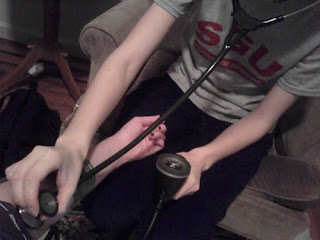
photo credit-irina slutsky
creative commons license
Like many Americans, I watched President Obama talk about his health care plan on TV tonight. Many others will comment on the plan in general, but I want to point out what I think are some possible implications for care of the disabled.
First of all, FULL DISCLOSURE-***I am a DOCTOR***. Now I know in a lot of people's minds that immediately may make them tune out anything that I will say, assuming that whatever I say will be self serving. I happen to think that since I have worked continuously in health care in one job or another continuously for decades (yikes!) that I may just have some insights into a couple of things. Your mileage may vary.
Basically, on the surface, today's talk by the President promised that nearly everyone will be covered, you won't lose your present doctor or insurance choice, you'll get all the health care you need, and it won't cost you or the country any more money. Sounds great, right?
Well, anyone with a lick of sense knows that all of that can't be true. So let's look at one of the things that WAS said, and think about it's implications.
One of the things that has been advocated (and that the President heartily endorses) is some sort of a national group of "health care experts" that would determine what treatments should be covered. This group would be a "non-partisan" group in Washington, D.C. This is being sold as "We'll eliminate unnecessary treatment", but there have been no parameters floated saying exactly what kind of treatments they will eliminate in order to save money.
I suspect that some of them may be reasonable, such as requiring prescription of generic drugs when available (though there are several times when patients react badly to a generic, and not to a brand name). Also, undoubtedly, many services for senior citizens will be either delayed or denied. Such things as hip replacements and knee replacements, as well as cataract surgery. Criteria will be imposed, and if someone is judged either to be not debilitated enough, or not to have enough useful years left, then they will be left without service. No one in the administration will admit this, but all healthcare economists pretty much agree on this. This is certainly what happens in other countries that have nationalized their healthcare system.
Now the reason I bring this anonymous, faceless committee up is the effect they may have on the disabled. The whole concept of futility and futile care has been big in ethical circles of late, and this concept is sure to enter into any decisions made by such a committee.
The problem becomes when this central committee decides on what constitutes futile care for a particular person. Instead of a decision being made with the person themself, their doctor, and their family (if the patient cannot communicate), this central committee will make decisions as to whether a particular person's life is worth investing more health care dollars into.
I don't know about you, but I don't have much trust that such a committee won't have an inbred bias against the disabled. Society as a whole is biased against the disabled, but society as a whole up to now hasn't been able to out and out condemn individuals to die from lack of treatment. Such a committee will.
For those of you that will disagree with me, ask your legislator if he/she can guarantee you that no disabled person will be denied care based on their disability. They can't.
Also one last thought for tonight. The non-partisan Congressional Budget Office predicts that millions of Americans will be forced out of their present insurance plans by the institution of Obamacare, and force into the "public option". The most telling thing (IMO) regarding the public option is that both the House of Representatives, as well as the President himself tonight, refuse to include themselves in the public option. The President waffled tonight when asked whether he would submit himself to the same requirements as the public option. The House last week voted down an amendment to the health care bill which would have required House members to take the public option.
If they don't want that option for themselves, why is it good enough for millions of other Americans?


